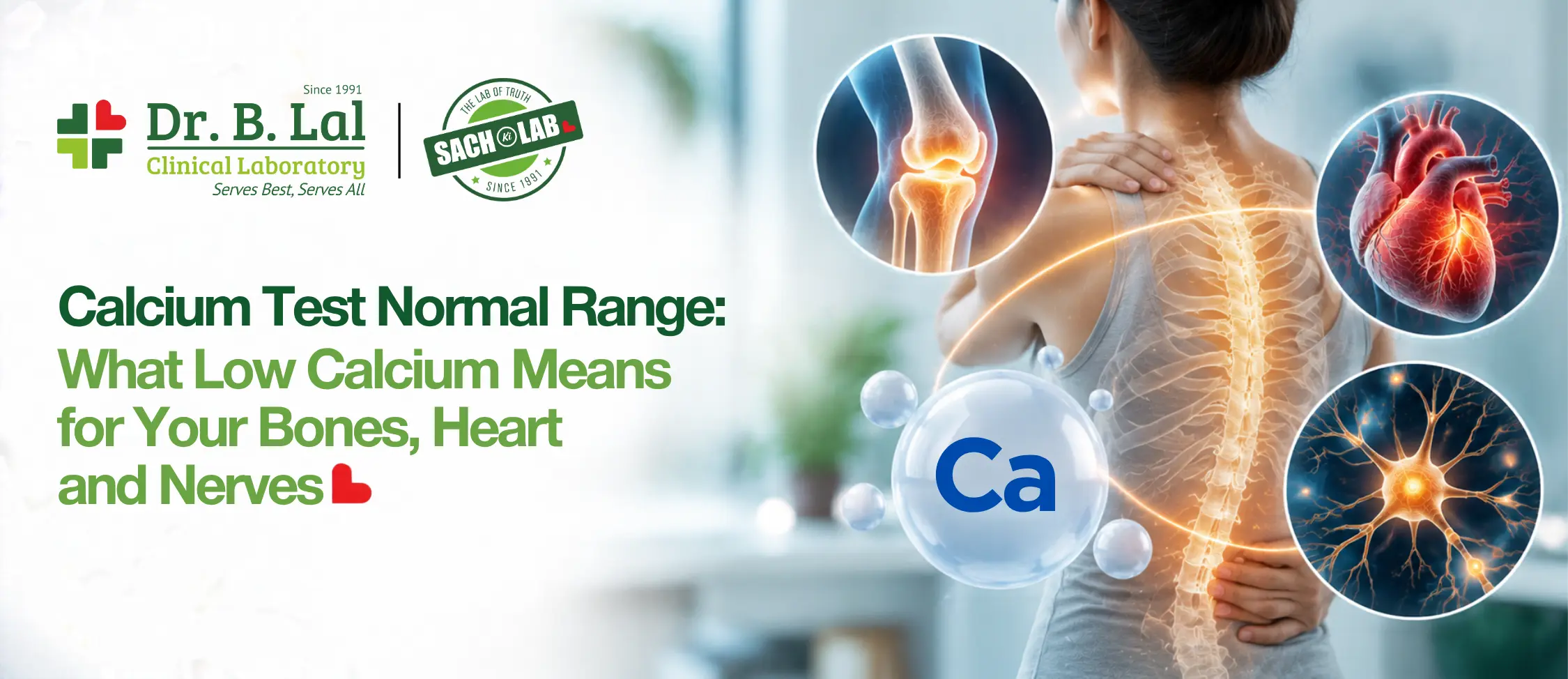
Most of us think of calcium as a bone thing. Drink your milk, grow strong bones, done. But the calcium in your blood has a very different job, and your body protects that number fiercely, because it keeps your heartbeat steady, your muscles moving and your nerves firing.
So when a report comes back with a calcium value marked low, it's worth understanding what that number actually says.
What the Calcium Blood Test Measures
About 99% of the calcium in your body sits in your bones and teeth. The remaining 1% travels in your blood, and that's what a calcium blood test checks.
There are two common versions. A total (serum) calcium test is the routine one, often part of a basic health panel. An ionized calcium test measures only the active, free portion, and doctors usually order it in hospital settings or when the total result doesn't match the symptoms.
Your doctor may also test albumin along with calcium. Albumin is a blood protein that carries part of the calcium, so low albumin can make total calcium look low even when the active calcium is fine.
Calcium Test Normal Range: What Counts as Normal?
Normal level of calcium in adults is about 8.6 to 10.2 mg/dL. Some laboratories use 8.5 to 10.5 mg/dL. So, you should always consult the reference range that is written on your test result sheet.
Ionized calcium is usually between 4.5 to 5.3 mg/dL (1.12 to 1.32 mmol/L). In some cases, children and infants have other ranges of calcium and it is indicated in the test result sheet.
Calcium concentration below the lower limit is hypocalcemia (meaning low calcium in blood). If it is higher than the upper limit, then it is hypercalcemia.
Low Calcium Symptoms: What You Might Notice
Mild hypocalcemia can pass with no symptoms at all, which is why it's often found by accident. When symptoms do show up, they tend to come from the nerves and muscles being a little too excitable.
- Tingling or numbness around the mouth, fingers and toes
- Muscle cramps, especially in the legs, back or hands
- Muscle twitching or spasms
- Tiredness and general weakness
- Brittle nails, dry skin and hair that breaks easily
- Irritability, anxiety or low mood
When calcium drops a lot, it can cause painful muscle spasms (tetany), confusion, seizures, a tight feeling in the throat or breathing trouble. These need urgent medical care.
What Low Calcium Means for Your Bones
There is a point which many people fail to note. Your body will always maintain a consistent level of calcium in the blood regardless of how much calcium you consume or how much you are able to absorb. In this case, the body simply removes the necessary calcium from your bones to keep the blood level constant.
This implies that even if you have normal levels of calcium in your blood, it doesn't mean that you are not having any weakening of your bones. Conversely, if you have consistently low levels of calcium in the blood, it could be due to the fact that the bones are already paying the price.
Eventually, you will end up having osteomalacia and rickets in adults and children respectively, or osteoporosis, whereby the bones become brittle and porous. Bone pain, fractures, and stooped posture will be the symptoms. DEXA test should be done to measure bone density.
What Low Calcium Means for Your Heart
Calcium is required for each heartbeat to occur properly. When there is a deficiency of calcium in the blood, the repolarization period for heartbeats can become prolonged. This condition is known as QT prolongation, which is recorded on an ECG. There is a risk of arrhythmia in individuals suffering from this problem.
You may experience palpitations, dizziness, and fainting. On rare occasions, there could be a weakening of the pumping action of the heart with a drop in the blood pressure in case of serious or longstanding hypocalcemia.
What Low Calcium Means for Your Nerves
Calcium is what keeps nerves relaxed. When there isn’t enough of it, they become hyperactive. Hence, the typical symptoms that are felt include numbness, tingling and muscle spasms. The doctor could tap on the cheek or inflate a blood pressure cuff to test whether there’s any twitching of the facial or hand muscles, respectively.
When the condition is not managed, the nervous system could be affected in a more severe manner. This would lead to seizures.
Causes of Hypocalcemia: It's Not Always About Diet
People assume low calcium means they're not eating enough dairy. Sometimes that's part of it, but there are other common reasons:
- Low vitamin D, very common in India, which stops the gut from absorbing calcium
- Low parathyroid hormone (hypoparathyroidism), sometimes after thyroid or neck surgery
- Kidney disease, which affects vitamin D activation and calcium balance
- Low magnesium, which interferes with the parathyroid hormone
- Digestive problems such as celiac disease, which reduce absorption
- Low albumin, which can make the report look low
- Certain medicines, including some diuretics and anti-seizure drugs
- Pancreatitis and other acute illnesses
This is why a doctor will usually look at more than the calcium value, and may add vitamin D, parathyroid hormone (PTH), phosphorus, magnesium, albumin and kidney function tests.
What to Do If Your Calcium Is Low
The treatment depends entirely on the cause. Mild cases are often managed with vitamin D and calcium, plus food changes. Severe cases may need calcium given through a drip in hospital.
A few practical points:
- Don't self-start high-dose calcium tablets. Too much can cause constipation and kidney stones, and it won't fix the problem if the real issue is vitamin D or the parathyroid.
- Eat calcium-rich foods: milk, curd, paneer, ragi, sesame (til), almonds, and greens like methi and sarson.
- Get some sun, since your skin makes vitamin D from it. Most adults need around 1,000 mg of calcium a day, but your doctor can give you a number that suits you.
- Follow up. Repeat the test when your doctor advises, to confirm the treatment is working.
See a doctor urgently if you have muscle spasms, seizures, chest discomfort, fainting or trouble breathing.
A Final Word
The figure in terms of calcium level is one simple number, but it might provide some insight into how well your bones, heart, and nerves function. It is not an issue to have a number that is somewhat low, while having normal level does not mean at all that your bones are healthy. The point is not in the number itself, but the explanation for the result and what your body says – whether it is pins and needles or frequent muscle cramps. When your report indicates low calcium levels, you should speak to a doctor and get to the bottom of the issue.