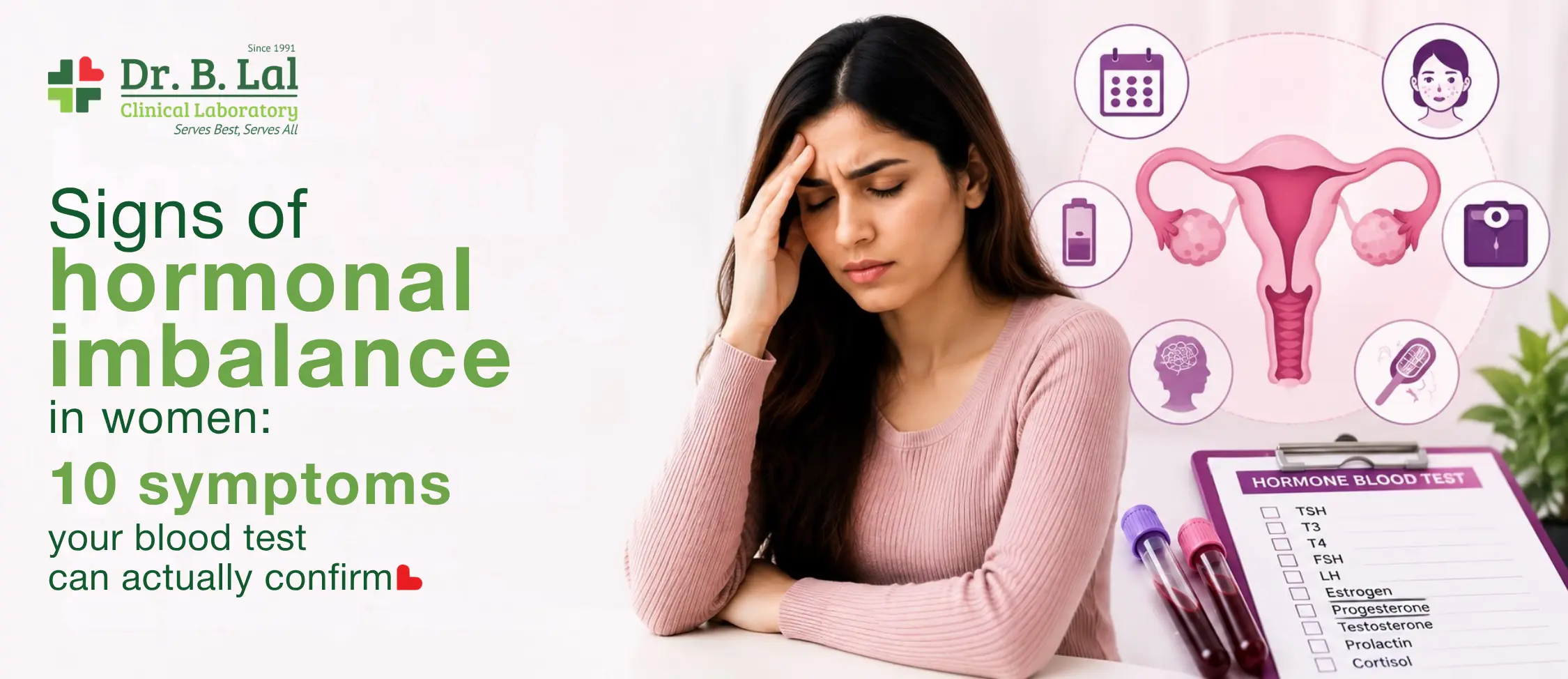
"Is it just stress, or is something actually off with my hormones?" It's one of the more common questions women bring to a doctor, and honestly, a fair one, hormonal imbalance symptoms overlap so heavily with stress, poor sleep, and normal aging that guessing from symptoms alone rarely gets you a straight answer. This is exactly why hormonal imbalance in women is something a blood test can genuinely confirm, rather than something you have to just live with wondering about.
Irregular or Missed Periods - What Confirms Hormonal Imbalance Here
Periods that show up unpredictably, skip months, or become unusually heavy or light are one of the clearest signals something hormonal is going on. The test that typically gets ordered here is a combination of FSH (follicle-stimulating hormone) and LH (luteinizing hormone). An elevated LH-to-FSH ratio, commonly 2:1 or higher, is a hallmark finding in PCOS, one of the most common causes of irregular periods in women of reproductive age. This ratio isn't just a curiosity either; a study of Indian women with PCOS found meaningfully elevated LH and altered hormone profiles compared to healthy controls, confirming this isn't a subtle or rare pattern.
Unexplained Weight Changes - What Confirms Hormonal Imbalance Here
Any change in weight that is not caused by a change in the individual’s eating habits or exercise regime will likely be due to an issue with their thyroid gland, and this is one of the simpler hormone imbalances to diagnose. A TSH test, possibly complemented by free T3 and T4, can detect both hypothyroidism (characterized by weight gain, tiredness, and sensitivity to cold) and hyperthyroidism (characterized by weight loss, heart palpitations, and anxiety). This imbalance is so prevalent among women that it may be the very first hormone test carried out by doctors who are diagnosing weight problems.
Persistent Fatigue - What Confirms Hormonal Imbalance Here
While fatigue can be incredibly nonspecific in and of itself, when paired with the correct lab tests, it becomes more precise quite quickly. Testing for thyroid function (TSH, T3, and T4) is done to rule out hypothyroidism, whereas the cortisol test determines whether the adrenal glands are making too much or too little of the main stress hormone in the body. Inaccurate levels of cortisol have been found to cause problems in menstruation and hormonal imbalances, hence the reason fatigue in women often leads to a whole battery of hormone tests.
Sudden Acne or Excess Facial Hair - What Confirms Hormonal Imbalance Here
Adult-onset acne, particularly along the jawline, or new hair growth in a male-pattern distribution, points toward elevated androgens, male hormones that all women produce in small amounts, but which can rise abnormally in certain conditions. Testosterone and DHEA-S (an androgen produced mainly by the adrenal glands) are the two tests that confirm this. Elevated androgen levels are considered a hallmark confirming feature of PCOS specifically, and DHEA-S elevation in particular can help distinguish an adrenal cause of the imbalance from an ovarian one.
Low Libido - What Confirms Hormonal Imbalance Here
A drop in sexual desire has several possible hormonal roots, which is why this symptom usually calls for a broader panel rather than a single test. Low testosterone, low estrogen, or thyroid dysfunction can all independently affect libido, and prolactin is also checked here, since abnormally high prolactin, a hormone primarily associated with milk production, can suppress reproductive hormone function and libido as a side effect.
Check your hormone imbalance now - Hormone Screening Package Female
Difficulty Conceiving - What Confirms Hormonal Imbalance Here
Fertility struggles are one of the areas where hormone testing plays the most direct, actionable role. FSH and LH assess ovarian reserve and ovulation patterns, progesterone confirms whether ovulation actually occurred in a given cycle, and prolactin and thyroid levels are checked since both can interfere with ovulation even when everything else appears normal. Low progesterone specifically can indicate that ovulation hasn't occurred, or that hormone production afterward is insufficient to support a pregnancy.
Mood Swings and Anxiety - What Confirms Hormonal Imbalance Here
Mood changes are genuinely difficult to attribute to hormones by symptoms alone, since mood is affected by so many other factors. Still, estrogen and progesterone fluctuations are well-documented contributors, alongside thyroid dysfunction, which frequently presents with anxiety or low mood as an early sign, well before more "classic" thyroid symptoms show up. A hormone panel covering estradiol, progesterone, and TSH together gives a reasonably complete first look here.
Hair Thinning or Hair Loss - What Confirms Hormonal Imbalance Here
Diffuse hair thinning, as opposed to isolated bald patches, often traces back to thyroid dysfunction, elevated androgens, or, during and after pregnancy, significant estrogen shifts. Testing typically includes TSH, testosterone, and DHEA-S, with the specific pattern of results helping distinguish between a thyroid cause and an androgen-related one, since the two require quite different approaches to manage.
Sleep Disturbances - What Confirms Hormonal Imbalance Here
Trouble falling or staying asleep, particularly when it develops alongside other symptoms on this list, is worth checking against cortisol and thyroid hormone levels, both of which directly influence the body's sleep-wake regulation. Estrogen and progesterone shifts around perimenopause are another well-established cause, which is why age and menstrual history matter as much as the blood values themselves when interpreting results here.
Vaginal Dryness and Discomfort - What Confirms Hormonal Imbalance Here
This symptom points fairly directly to declining estrogen, most commonly seen during perimenopause and menopause. An estradiol (estrogen) test confirms the drop, and it's typically interpreted alongside FSH, since FSH characteristically rises as ovarian estrogen production declines, the two values together give a clearer picture of where someone actually is in the menopausal transition than either number alone.
Why Testing Matters More Than Guessing From Symptoms
All the symptoms mentioned above have something in common with stress, lack of sleep, other diseases, or simply aging; and this is exactly what makes hormone tests more accurate than matching symptoms in diagnosing the problem. The choice of appropriate panel is greatly dependent on age, whether menstruation is regular, and what symptoms the patient experiences, and that is exactly why a physician chooses which combination of tests should be done instead of ordering all kinds of hormone tests for everybody. It is important to note that such hormones as thyroid and prolactin are checked in order to identify mimics; for example, high levels of prolactin may lead to irregular periods that look exactly the same as PCOS.
Conclusion
Hormonal imbalance in women produces a genuinely wide range of symptoms, and almost none of them are exclusive to hormones alone, which is precisely why a blood test, not guesswork, is what actually confirms what's going on. If several of the symptoms above sound familiar, the right next step isn't trying to self-diagnose which hormone is responsible, but talking to a doctor about which specific panel makes sense for your age, cycle, and symptom pattern.