If you've had a kidney function test or a routine blood panel done recently, there's a good chance your report includes a number labelled eGFR. It's one of those results people often skim past without quite knowing what it represents - until a doctor mentions it, or the number falls outside the expected range. Since eGFR is one of the most reliable single indicators of how well your kidneys are working, it's worth understanding what it actually measures and what your number means.
What GFR and eGFR Actually Are
GFR stands for glomerular filtration rate - a measure of how much blood your kidneys filter each minute. The glomeruli are the tiny filtering units inside the kidneys that remove waste products and excess fluid from the blood while holding on to things the body needs, like proteins and blood cells. The faster and more completely this filtering happens, the better your kidneys are functioning.
Measuring true GFR directly is complicated and rarely done outside research settings, since it involves injecting a marker substance and tracking its clearance. In everyday clinical practice, doctors instead use eGFR - estimated GFR - which is calculated using a formula based on your blood creatinine level, along with age, sex, and sometimes body size. Creatinine is a waste product from muscle activity that healthy kidneys clear efficiently; when kidney function declines, creatinine builds up in the blood, and the eGFR formula converts that into an estimated filtration rate, expressed in mL/min/1.73 m².
What Counts as a Normal eGFR
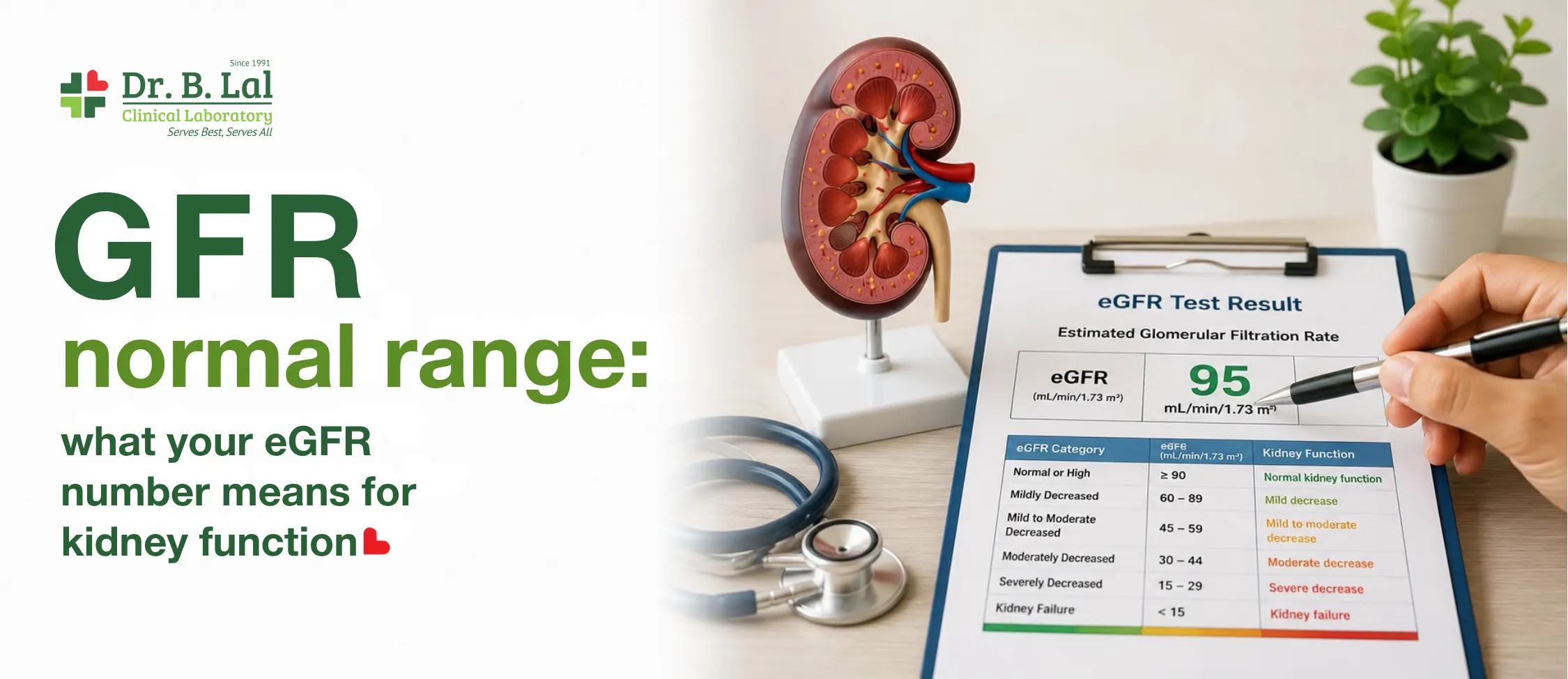
A young, healthy adult typically has an eGFR somewhere between 90 and 130 mL/min/1.73 m². As a general reference point, doctors classify eGFR into six categories, known as G1 through G5 (with G3 split into two sub-stages):
| Stage | eGFR (mL/min/1.73 m²) | What It Indicates |
| G1 | 90 or above | Normal or high kidney function |
| G2 | 60–89 | Mildly reduced function |
| G3a | 45–59 | Mild to moderate reduction |
| G3b | 30–44 | Moderate to severe reduction |
| G4 | 15–29 | Severe reduction |
| G5 | Below 15 | Kidney failure |
An important consideration here is that an eGFR classified as G1 or G2 (greater than 60) would be regarded as indicative of CKD only when accompanied by other evidence of renal damage, for instance protein in the urine (albuminuria), presence of blood in the urine, or structural abnormality shown on imaging. In absence of any such further indication, an eGFR greater than 60 would still be classified as within the normal functioning range, despite being low for normal values.
An eGFR that stays below 60 for three months or more, on the other hand, is diagnostic of chronic kidney disease regardless of whether other damage markers are present, simply because that level of reduced filtration on its own indicates a meaningful loss of kidney function.
Why Age Changes the Picture
One detail that surprises a lot of people: eGFR naturally declines with age, even in healthy individuals with no kidney disease. Kidney function tends to peak in your twenties and gradually decreases from there - often by roughly 1 mL/min per year after around age 40. This means an eGFR of 65 might be unremarkable in a 70-year-old but could represent a meaningful drop in someone in their 40s.
This is exactly why eGFR shouldn't be read in isolation. A single number without context - your age, your baseline history, whether protein is showing up in your urine — only tells part of the story. Doctors typically look at the trend over time, alongside a urine albumin-creatinine ratio (ACR) test, to build a fuller picture of kidney health.
What a Low eGFR Means for You
If your eGFR comes back lower than expected, it doesn't automatically mean a serious problem. A number of things can temporarily lower eGFR readings, including dehydration, a recent illness or infection, certain medications, high muscle mass (which affects creatinine levels), or a high-protein meal shortly before the blood draw. This is one reason doctors often repeat the test before drawing conclusions.
If a lower eGFR is confirmed on repeat testing, especially alongside elevated urine ACR, it points toward reduced kidney function that needs monitoring or treatment. The most common underlying causes are diabetes and high blood pressure, both of which damage the small blood vessels within the kidneys over time. Other causes include glomerular diseases, recurrent kidney infections, kidney stones causing obstruction, and certain hereditary conditions.
Based on the stage, treatment may involve managing high blood pressure, management of blood sugar in case of diabetes, changes in diet (e.g., reducing intake of proteins, salt, potassium, and phosphate at the later stages), avoidance of medications harmful to the kidneys, and monitoring of the disease’s progress by a nephrologist.
When to Get Your eGFR Checked
Testing is generally recommended:
- Annually for anyone with diabetes or high blood pressure
- As part of routine health check-ups for adults over 60
- If there's a family history of kidney disease
- When investigating symptoms like persistent fatigue, swelling in the legs or around the eyes, changes in urination, or unexplained nausea
Conclusion
The eGFR is a simple yet effective test for understanding how well the kidneys are functioning. A level of 90 or higher is good news, levels between 60 and 80 are usually considered to be within normal range, although even if they are not, with age, it is good to monitor these levels and anything less than 60 should be looked into by your doctor. Like any other laboratory value, what is important is the pattern it shows over several tests.