
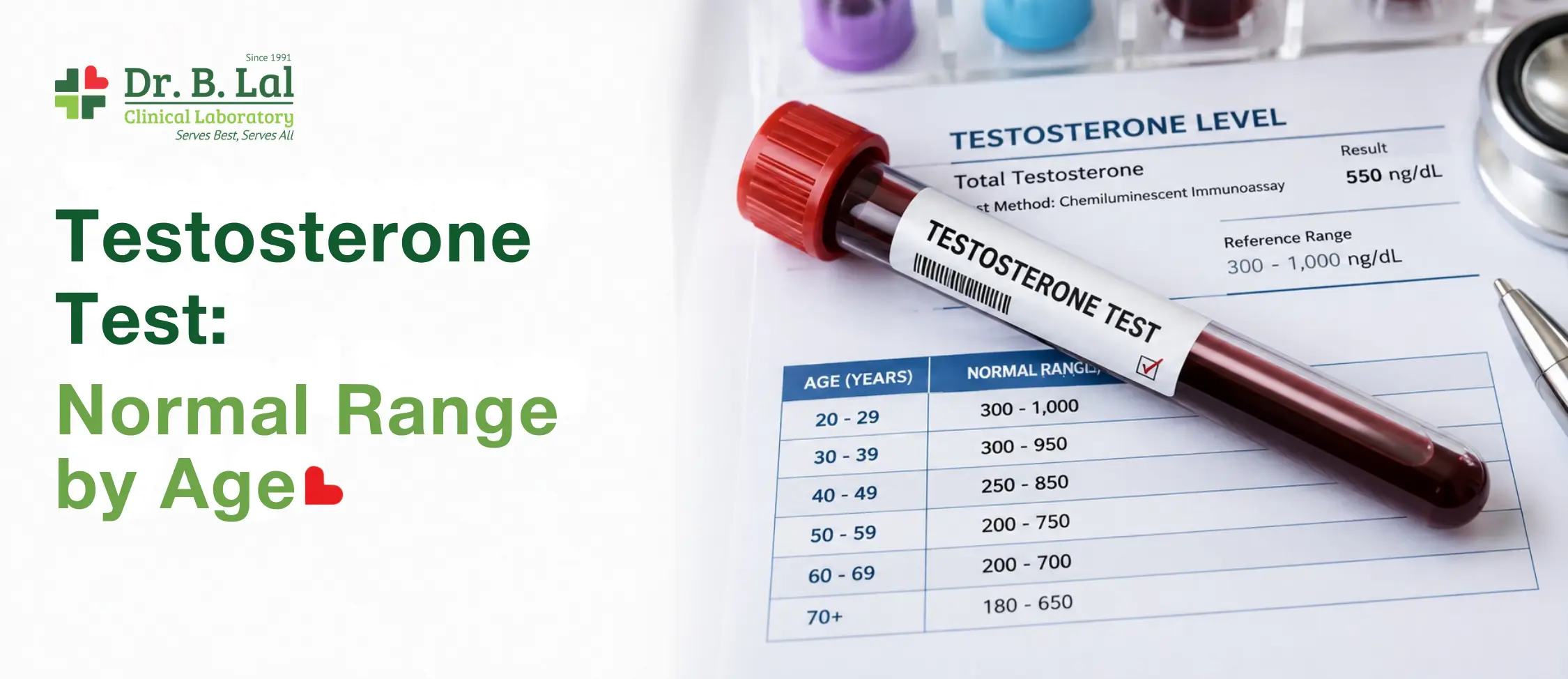
Someone gets a testosterone test back showing 450 ng/dL and has no idea whether that's good, bad, or completely unremarkable, and honestly, the answer genuinely depends on how old they are, which lab ran the test, and what symptoms, if any, they're actually dealing with. Testosterone is one of those results where the number by itself tells you surprisingly little without the right context around it.
Why a Testosterone Test Needs an Age-Based Range to Mean Anything
Testosterone isn't a fixed number the body maintains throughout life, it follows a fairly predictable arc, rising sharply through puberty, peaking in the late teens to early twenties, and then gradually declining from around age 30 onward. This is exactly why a testosterone test result needs to be read against an age-appropriate range rather than a single universal cutoff. A level that's completely normal for a 55-year-old could suggest a real problem in a 25-year-old, and vice versa in the other direction.
Testosterone Normal Range by Age in Men
For adult men aged 19 and older, most reference ranges put total testosterone somewhere between 240 and 950 ng/dL, though this varies meaningfully by lab, some labs use ranges extending closer to 264–916 ng/dL, others run as high as 1,100 ng/dL at the upper end. This range difference matters more than people realise: the same actual result can read as "low" at one lab and "normal" at another, purely based on which reference range that specific lab uses.
Broken down by decade, testosterone in men typically follows this rough pattern:
- 20s: Peak levels, averaging roughly 600–700 ng/dL
- 30s: The gradual decline begins, generally around 1–2% per year
- 40s: Average total testosterone around 480–600 ng/dL, with a normal range typically cited as roughly 250–750 ng/dL
- 50s and beyond: Most men have lost somewhere between 20 and 30% of their peak testosterone by age 50, continuing a similar gradual decline
Here's a genuinely interesting nuance that gets missed in most consumer content: a large, carefully validated study modelling age-related testosterone found that while levels do fall from the late teens through around age 40, there's no strong evidence of a further decline in average testosterone from 40 onward, though variability between individuals increases substantially with age. In other words, the popular idea of testosterone steadily dropping every single year indefinitely isn't quite what the most rigorous data shows; a meaningful part of the "decline" happens earlier than people assume, and what looks like continued decline later in life is partly increased variation between different men, not a uniform downward trend for everyone.
Testosterone Normal Range by Age in Women
Women produce testosterone too, just in much smaller amounts, and the normal range reflects that. During the reproductive years, normal total testosterone in women is generally cited as roughly 15–70 ng/dL, gradually declining to around 8–35 ng/dL after menopause. One detail worth knowing: testosterone in women often drops by about half between their 20s and mid-40s, well before menopause itself actually occurs, which surprises a lot of women who assume hormonal shifts are exclusively a menopause-era event.
Reference ranges for women are also less standardised than men's, largely because most testing assays were originally built and calibrated for the much higher concentrations found in men. Because of this, testosterone results in women are generally interpreted alongside free testosterone and SHBG (sex hormone-binding globulin) levels, and critically, alongside symptoms, rather than as a single isolated number. Unusually high testosterone in a woman is a different story entirely from normal aging, and typically points toward PCOS, insulin resistance, or in rarer cases, an androgen-secreting condition.
Total Testosterone vs. Free Testosterone on a Testosterone Test
A standard testosterone test usually reports total testosterone, but this only tells part of the story. Most testosterone in the bloodstream is bound to proteins, primarily SHBG, and isn't biologically active, it's the smaller, unbound fraction, free testosterone, that actually does the work in your body's tissues. Free testosterone tends to decline somewhat faster than total testosterone with age, largely because SHBG levels tend to rise as men get older, binding up more of the total testosterone that's present and leaving less of it free and active. This is exactly why doctors will sometimes order total testosterone, free testosterone, and SHBG together for a more complete picture, rather than relying on total testosterone alone.
Why the Testosterone Test Number Alone Isn't the Whole Story
This is worth being direct about: a low testosterone diagnosis genuinely requires symptoms alongside an abnormal lab value, not the number by itself. Many men have testosterone readings somewhat below the standard range without any symptoms they're concerned about, and many clinicians won't treat this as a problem requiring intervention on the number alone. It's also worth knowing that testosterone testing has a real retest rate, around 30% of men whose first test comes back low turn out to be within normal range on a repeat test, which is exactly why a single low reading, taken in isolation, usually isn't treated as conclusive.
Testing conditions matter too. Testosterone follows a daily rhythm, peaking in the morning, which is why testing is generally recommended between 7 and 10 am, typically fasting, for the most accurate and comparable reading.
When Low Testosterone Deserves Closer Attention
Age matters here more than people expect. Low testosterone in a man under 30 is considered more concerning than the same finding in an older man, since it's more likely to point toward an underlying medical issue, a pituitary, testicular, or genetic cause, rather than simply reflecting ordinary age-related decline, which explains the vast majority of low readings in men over 50.
Conclusion
A testosterone test result only really makes sense once it's read against the right age-based range, ideally alongside free testosterone and SHBG, and always alongside actual symptoms rather than the number in isolation. The normal range shifts substantially across a lifetime, for men, from a peak in the 20s through a gradual decline that levels out more than most people expect after 40; for women, through a more gradual, decades-long decline that often begins well before menopause. If your testosterone test result seems unusual, the right next step isn't comparing it to a chart found online, but discussing it with a doctor who can weigh it against your specific age, symptoms, and lab's reference range.