Two people get an ultrasound. One report says "Grade 1 fatty liver." The other says "Grade 2." On paper, it looks like a small difference, just one number. In reality, that single digit changes quite a bit about what happens next: how closely it needs monitoring, how likely it is to cause real problems down the line, and how urgently lifestyle changes actually need to happen. Understanding what separates Grade 1 vs Grade 2 fatty liver helps make sense of a report that otherwise just looks like two similar-sounding phrases.
How the Grade 1 vs Grade 2 Fatty Liver Distinction Is Actually Made
Fatty liver, medically called hepatic steatosis, happens when fat builds up in liver cells beyond what's considered normal, generally more than 5 to 10% of the liver's weight. Doctors most commonly assess severity through an ultrasound, which measures how much brighter, or "echogenic," the liver appears compared to the kidney or spleen. More fat in the liver tissue shows up as more brightness on the scan, along with specific changes in how clearly certain structures can be seen.
The formal grading criteria break down like this:
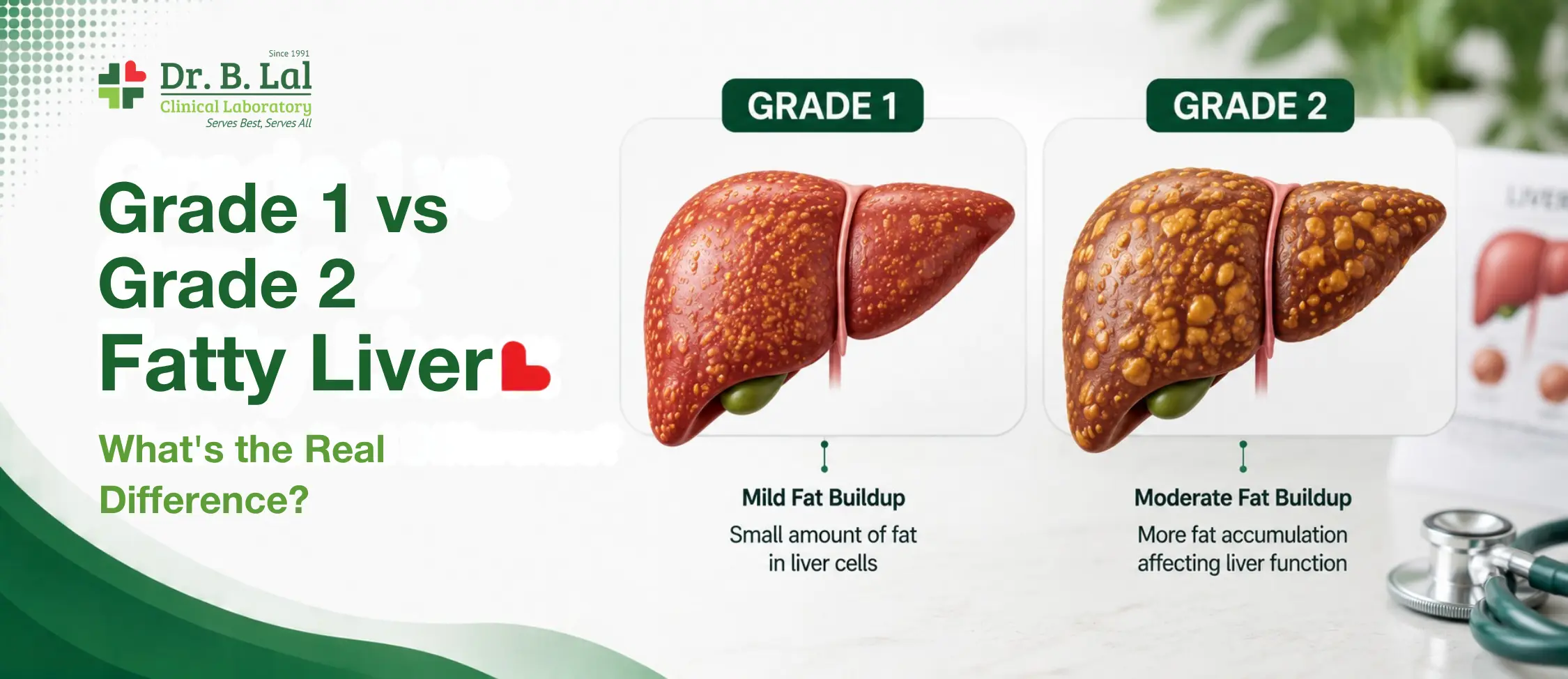
- Grade 1 (mild): A slight, diffuse increase in liver brightness, with the diaphragm and blood vessel borders inside the liver still clearly visible
- Grade 2 (moderate): A more noticeable increase in brightness, with slightly impaired visibility of the intrahepatic vessels and diaphragm
- Grade 3 (severe): Marked brightness with poor or no visibility of vessel borders, the diaphragm, and the back portion of the liver's right lobe.
In terms of actual fat percentage, Grade 1 typically corresponds to roughly 5–33% fat content, while Grade 2 sits around 34–66%. That range matters more than it might seem, it's the difference between a liver quietly storing a bit of extra fat and one where the fat load has become substantial enough to start causing real cellular stress.
Grade 1 vs Grade 2 Fatty Liver: Symptoms and How They're Found
Grade 1 fatty liver is, more often than not, a silent finding. Most people have no symptoms at all, and it typically turns up incidentally, an ultrasound done for something entirely unrelated, or a routine health check-up. On the rare occasion symptoms do show up at this stage, they're usually mild and easy to dismiss, like a slight sense of heaviness in the upper abdomen.
Grade 2 fatty liver is more likely to actually announce itself, though the symptoms still tend to be fairly nonspecific: fatigue, a dull ache or fullness in the upper right abdomen, mild bloating, or unexplained sluggish weight changes. Some people also see mildly elevated liver enzymes on blood work at this stage, even without any physical symptoms, another reason routine bloodwork sometimes catches Grade 2 fatty liver before anything feels obviously wrong.
Grade 1 vs Grade 2 Fatty Liver: Why the Risk Level Actually Differs
This is when the difference goes beyond being academic. In Grade 1, the accumulation of fat occurs with very little other activity happening in the liver, no inflammation present at all, and the condition seen as highly reversible through relatively minor lifestyle changes. In Grade 2, there becomes the definite presence of a risk factor, as the body's fat content has potentially reached a level where low-level inflammation occurs inside the liver, which is what actually causes the problem to develop into something more serious down the road.
The risk isn't confined to the liver either. Research has found that fatty liver disease, particularly from Grade 2 onward, carries an independently elevated risk of cardiovascular disease, and in a fair number of NAFLD patients, heart disease actually turns out to be a bigger threat to long-term survival than liver damage itself. The shared root cause, insulin resistance, poor cholesterol balance, high blood pressure, explains why fatty liver and heart risk tend to travel together. Grade 2 has also been associated with higher rates of chronic kidney disease and, in some large studies, an increased risk of new-onset atrial fibrillation, with risk climbing progressively as the grade increases.
Liver health is the top priority; check your liver health now - Liver Function Test
Grade 1 vs Grade 2 Fatty Liver: What Changes in Terms of Management
For Grade 1 fatty liver, the approach is usually fairly light-touch: dietary changes, more physical activity, and a repeat ultrasound down the line to confirm things are moving in the right direction, often without needing frequent specialist visits.
Grade 2 fatty liver usually necessitates a more regimented approach. This would entail monitoring of liver enzyme levels, metabolic screening for associated problems (such as glucose, cholesterol, triglyceride levels), and sometimes an image test such as a FibroScan test to detect any developing fibrosis, which is not commonly required in a Grade 1 situation. The lifestyle measures recommended would be much the same as those mentioned in Grade 1, but would be undertaken more urgently and with more oversight due to the fact that there is more leeway for further deterioration in this case.
Grade 1 vs Grade 2 Fatty Liver: Can Both Be Reversed?
Yes, and this is genuinely the most reassuring part of the comparison. Both grades are considered reversible with consistent effort, the liver has a real capacity to shed excess fat once the underlying drivers are addressed. Losing around 7–10% of body weight, cutting back on refined sugar and processed food, staying physically active, and managing related conditions like diabetes or high cholesterol all measurably reduce liver fat at either stage.
It basically comes down to a matter of margin for error and time frame. Grade 1 can be corrected with relatively minor improvements over the course of several months. Grade 2 generally requires more persistent effort, and physicians prefer to see that the condition is actually improving, rather than gradually deteriorating into Grade 3.
When to See a Doctor
If you are informed of being a Grade 1 or a Grade 2 patient, it is advisable to investigate this further and not put the report aside, especially if there are any risk factors such as obesity, diabetes, high cholesterol, or any family history of liver disease. If the diagnosis is a Grade 2 patient or even the abnormal findings for liver enzymes for both grades, it is necessary to see a physician sooner.
Conclusion
Grade 1 vs Grade 2 fatty liver comes down to more than just a number on a report, it reflects a genuine difference in how much fat has accumulated, how likely inflammation has already started, and how urgently changes need to happen. Both stages are largely reversible, which is the encouraging part, but Grade 2 carries a meaningfully higher risk of quietly progressing toward more serious liver and cardiovascular problems if it's left unaddressed. Either way, the report is a prompt to act, not a verdict to worry over in isolation.