
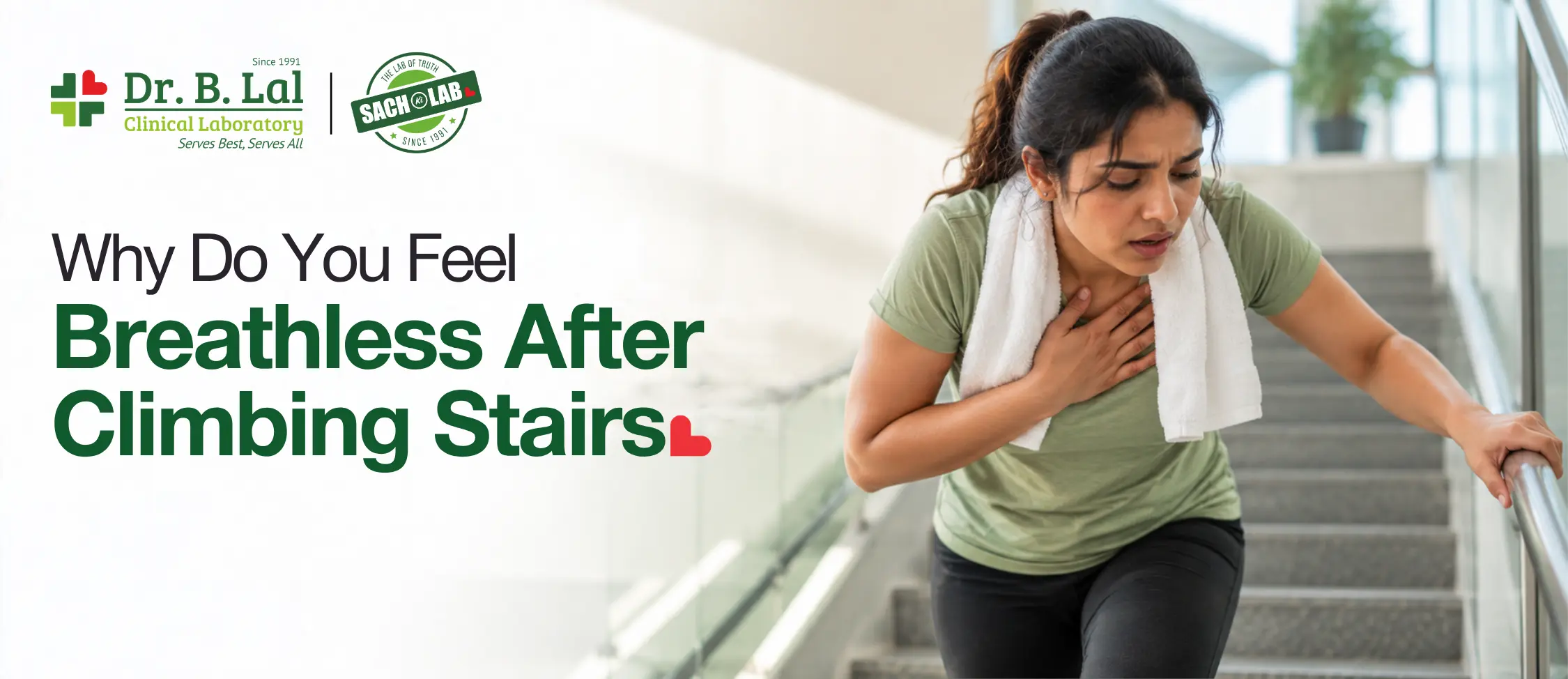
Stairs have an odd way of exposing things that flat ground quietly hides. Someone can walk a kilometre on level pavement without a second thought, then reach the second floor of a building and suddenly feel like they've run a race. That's not a coincidence or a sign of unusual laziness, climbing stairs increases the body's oxygen demand by up to 200% compared to walking on flat ground, which makes stairs one of the first places any weakness in the body's oxygen-delivery chain — heart, lungs, blood, or muscles — actually shows up.
Why Climbing Stairs Makes You Breathless in the First Place
Stairs force your body to lift its own body weight vertically, step after step, which is a fundamentally harder task than moving the same distance horizontally. This sharply increases the workload placed on your heart, lungs, and leg muscles all at once. If any part of that oxygen-delivery chain is underperforming, even slightly, you tend to notice it first on stairs, often within 10 to 20 seconds of starting, well before it would show up during ordinary walking.
Feeling Breathless After Climbing Stairs Because of Deconditioning
This is genuinely the most common explanation, and the most reassuring one. After roughly two months of reduced physical activity, mitochondrial density in leg muscles, essentially, the cellular machinery that uses oxygen efficiently, drops by around 10%, which means the same physical effort now costs more oxygen than it used to. If you've been largely sedentary for weeks or months, some breathlessness on stairs is a fairly predictable, low-concern finding rather than a red flag. The reassuring signs that this is likely just deconditioning: breathing returns to normal fairly quickly once you stop, there's no chest pain, dizziness, or ankle swelling involved, and the breathlessness genuinely improves over a few weeks of gradual, regular activity.
Feeling Breathless After Climbing Stairs Because of Anemia
Anemia reduces the number of red blood cells available to carry oxygen through the body, and stairs, with their sudden spike in oxygen demand, expose this shortage quickly. The numbers here are genuinely striking: hemoglobin below 11 g/dL can reduce VO2 max, a measure of how efficiently your body uses oxygen, by around 15%, which is enough to cause noticeable panting after just 6 to 8 steps in some people. This is exactly why unexplained breathlessness on stairs, especially alongside fatigue or pale skin, is often investigated with a simple blood test rather than assumed to be a fitness issue.
Feeling Breathless After Climbing Stairs Because of Heart Problems
Several cardiac conditions can specifically make stairs disproportionately difficult, even when the same person feels fine on flat ground. Heart failure — where the heart muscle has become too weak or stiff to pump blood efficiently, can cause fluid to build up in the lungs, making the extra demand of climbing genuinely harder to meet. Coronary artery disease is a particularly sneaky cause here: a 50% blockage in a coronary artery might be completely silent during ordinary daily activity, yet cut stair-climbing capacity by roughly 30%, since stairs push cardiac demand high enough to expose a narrowing that flat-ground walking never would. Arrhythmias — irregular heart rhythms, including atrial fibrillation — can similarly reduce how efficiently the heart pumps blood during exertion, and longstanding high blood pressure can gradually change heart structure in ways that eventually show up as exertional breathlessness too.
Feeling Breathless After Climbing Stairs Because of Lung Conditions
Both asthma and chronic obstructive pulmonary disease (COPD) limit the flow of air, which limitation occurs to a much greater extent due to increased ventilatory demands that stair climbing entails. One of the tests used to diagnose both diseases is the FEV1 (forced expiratory volume in one second) which, when reduced by 20 percent from its predicted normal level, approximately doubles the difficulty experienced when climbing stairs despite the patient being able to breathe normally at rest. In the case of COPD, the disease has a slowly progressive nature particularly among smokers and shortness of breath while climbing stairs is one of the early symptoms.
Feeling Breathless After Climbing Stairs Because of Other, Less Obvious Causes
A handful of other factors can genuinely contribute, and they're worth ruling out precisely because they're often missed: obesity, since extra body weight directly increases the oxygen cost of lifting yourself up each step; thyroid dysfunction, which affects the body's metabolic and oxygen demands more broadly; certain medications; high altitude; and anxiety, which can produce a very real sensation of breathlessness through changes in breathing pattern, independent of any actual oxygen delivery problem.
When Feeling Breathless After Climbing Stairs Is Genuinely Normal
Occasional mild breathlessness on stairs is common and, on its own, isn't automatically a red flag, particularly if you've been less physically active recently, if the feeling resolves quickly once you stop and rest, and if there's no chest pain, dizziness, or swelling involved. As one physician put it plainly: getting a little winded on stairs isn't automatically concerning, especially with a recent drop in activity — what matters more is the pattern over time, not any single instance.
When Feeling Breathless After Climbing Stairs Needs Medical Attention
The pattern really is the key signal here, more than the breathlessness itself. It's worth seeing a doctor if the breathlessness is new for you rather than long-standing, if it's been getting worse over weeks or months rather than staying the same, or if it happens even when you don't feel like you're working particularly hard. Beyond the pattern, certain accompanying symptoms warrant prompt medical evaluation regardless of how recent the change is: chest pain or pressure, dizziness or lightheadedness, swelling in the ankles or legs, a persistent cough, or breathlessness that develops suddenly, worsens quickly, or occurs even at complete rest.
How Doctors Actually Figure Out the Cause
As there are many different overlapping systems that could result in being out of breath going up stairs, usually a history and physical examination is done first, followed by tests based on the suspected cause, blood tests to rule out anemia or thyroid disease, an ECG or echocardiogram for heart function, chest imaging and pulmonary function tests. When further investigation has not identified the problem, CPET (cardiopulmonary exercise test) may be done which would help to differentiate whether the limitation is cardiac, pulmonary or fitness-based, and studies show that about one-third of cases will have their problem identified in this manner.
Conclusion
Difficulty breathing following stair climbing is a problem that is quite common, and the reason for this could either be as straightforward and treatable as poor physical condition or as serious as conditions such as anemia, heart disease, or lung disease. The factor that is most important to focus on is not the breathlessness itself, but rather the context in which it arises—whether or not it is recent, worsening, or accompanied by other factors such as chest pain or swelling. A relatively simple battery of tests should be enough to distinguish between the two possibilities.