HR teams putting together an annual health checkup for the first time tend to reach for whatever package a diagnostic provider hands them, assuming more tests automatically means better coverage. It doesn't quite work that way. The right employee health checkup isn't the one with the longest test list — it's the one that actually matches who's being screened, since a 25-year-old field engineer and a 50-year-old desk-based executive have genuinely different risk profiles, and a single generic panel serves neither particularly well.
What an Employee Health Checkup Should Include as a Core Panel
Regardless of age or role, a handful of tests form the reasonable baseline for almost any employee health checkup, since they catch the conditions responsible for the bulk of preventable workplace health costs:
- Complete Blood Count (CBC) — detects anemia, infection, and general immune status
- Blood sugar (fasting glucose and/or HbA1c) — screens for diabetes and prediabetes, both increasingly common in working-age adults
- Lipid profile — measures total cholesterol, HDL, LDL, and triglycerides, the core markers for cardiovascular risk
- Liver function test — checks enzymes, proteins, and bilirubin, relevant given how common fatty liver has become even in non-drinkers
- Kidney function test — creatinine and related markers, since kidney disease is frequently silent until fairly advanced
- Thyroid profile (TSH, and T3/T4 where needed) — genuinely common in working professionals and easy to miss without direct testing
- Urine routine — checks for protein, glucose, and early signs of kidney or urinary issues
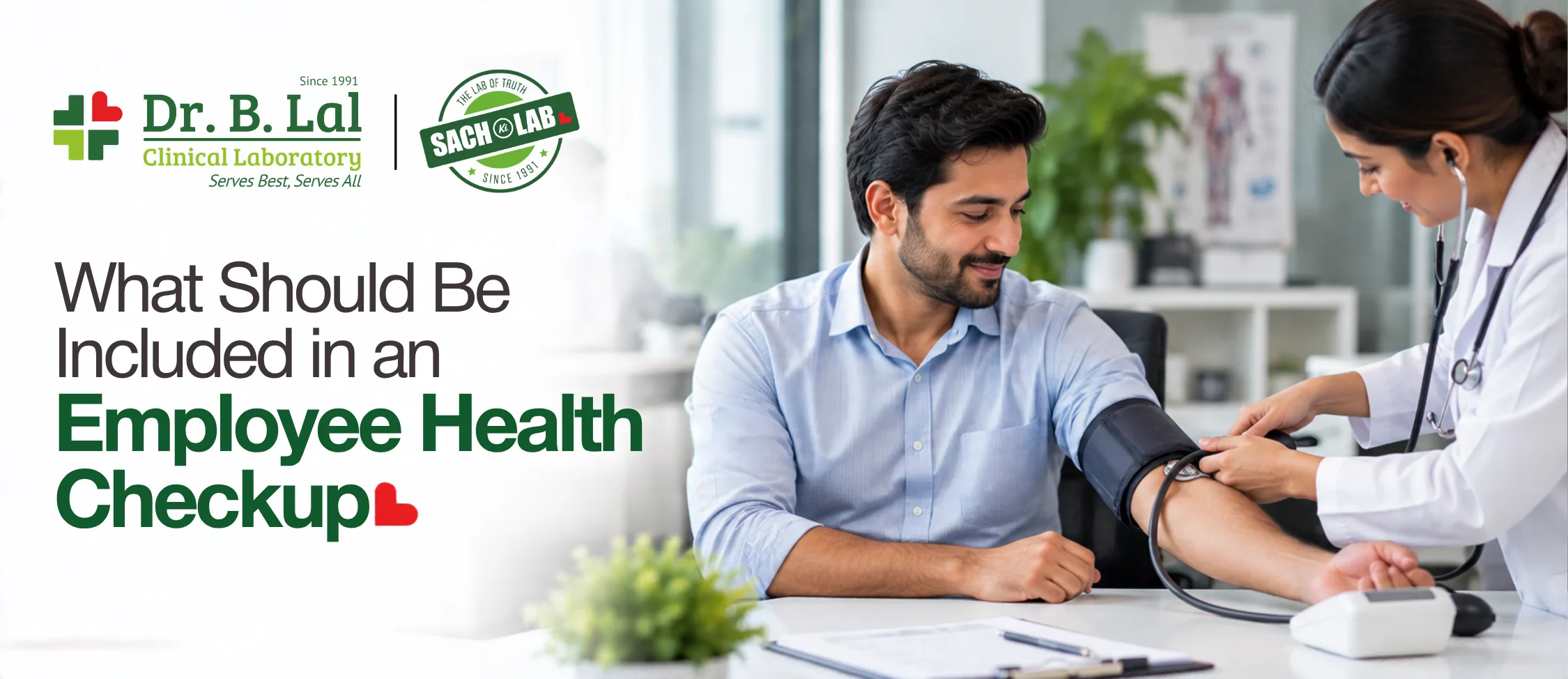
- Blood pressure and BMI — simple, fast, and genuinely predictive of downstream risk
This core panel is deliberately broad rather than exhaustive — it's built to catch the handful of conditions (diabetes, hypertension, dyslipidemia, thyroid dysfunction) that account for most of the preventable chronic disease burden in a working-age population, without loading the checkup with tests that add cost without adding much real signal for most employees.
What an Employee Health Checkup Should Include Based on Age
An employee health checkup for a 24-year-old and one for a 55-year-old shouldn't look identical, and current guidance is fairly consistent on this point. For employees over 35, or anyone with existing cardiovascular risk factors, an ECG is commonly added to the core panel to check for arrhythmias or signs of past cardiac strain. Beyond 40 to 45, more comprehensive full-body packages become more clinically justified — vitamin D and B12 levels, uric acid, and in some cases an abdominal ultrasound looking at the liver, gallbladder, and kidneys. Employees over 30 are generally advised to have a complete health checkup annually rather than every few years, since the risk profile for several key conditions shifts meaningfully in this decade.
What an Employee Health Checkup Should Include for Gender-Specific Screening
A genuinely complete employee health checkup accounts for gender-specific risks rather than applying one identical panel to everyone. For women, this can include screening relevant to reproductive and hormonal health depending on age. For men over 50, a PSA (prostate-specific antigen) test is commonly included in more comprehensive or executive-tier packages. These additions don't need to be part of every single employee's package by default, but they should be available as an option, since leaving them out entirely means a meaningful share of the workforce goes unscreened for conditions specific to them.
What an Employee Health Checkup Should Include Based on Job Role
This is one of the more overlooked design factors, and it genuinely matters. A desk-based, largely sedentary workforce — IT teams, back-office staff — benefits from a panel weighted toward the risks of prolonged sitting and screen time: lipid profile, HbA1c, thyroid, vitamin D and B12, an eye examination, and increasingly, some form of mental health or stress screening, given how much desk-based, high-pressure work contributes to burnout. A factory or field workforce, by contrast, has different priorities — occupational fitness assessment, hearing and vision checks relevant to the specific work environment, and screening tied to any physical or chemical exposure the role involves. Senior leadership and executive teams are often offered more comprehensive packages, partly reflecting age and partly reflecting the outsized organisational cost of an unexpected health event at that level.
What an Employee Health Checkup Should Include as Advanced or Executive-Tier Additions
For senior employees, or organisations opting for a more premium tier, additional tests are commonly layered onto the core panel: a chest X-ray, an abdominal ultrasound covering the liver, gallbladder, pancreas, and kidneys, tumor markers relevant to age and gender where clinically appropriate, and in some cases, a bone density scan for employees at higher risk of osteoporosis. These aren't necessary for every employee, and adding them indiscriminately mostly drives up cost without proportionate benefit — they're best reserved for age groups or risk profiles where the added test genuinely changes the odds of catching something significant early.
What an Employee Health Checkup Should Include Beyond the Lab Tests
A checkup built purely around blood work misses part of the picture. A brief physician consultation to actually interpret results in context, rather than handing over a printout of numbers, makes a measurable difference in whether findings translate into any real follow-up action. Basic physical measurements — height, weight, waist circumference — and a general physical exam round out what a lab panel alone can't capture, and for organisations with roles involving physical exertion, some assessment of occupational fitness for the job itself is worth including.
Why the Right Employee Health Checkup Depends on Who's Being Screened
The single most useful design principle here is genuinely simple: the appropriate combination of tests depends on the age, health history, occupational risk, and role profile of the people being screened — not on picking whichever package sounds most comprehensive on a vendor's price list. A small team of young, healthy employees is reasonably served by the core panel alone. A larger, older, or more occupationally exposed workforce justifies a broader, more tiered approach, ideally with input from a healthcare professional on what actually fits the specific group rather than a one-size-fits-all default.
Conclusion
A well-designed employee health checkup starts with a solid core panel — CBC, blood sugar, lipids, liver and kidney function, thyroid, and blood pressure — and builds outward from there based on age, gender, and the specific demands of the role being screened, rather than defaulting to the longest test list available. The goal isn't maximum coverage for its own sake; it's a panel that actually matches the real risk profile of the people taking it, backed by a consultation that turns the results into something employees can genuinely act on.