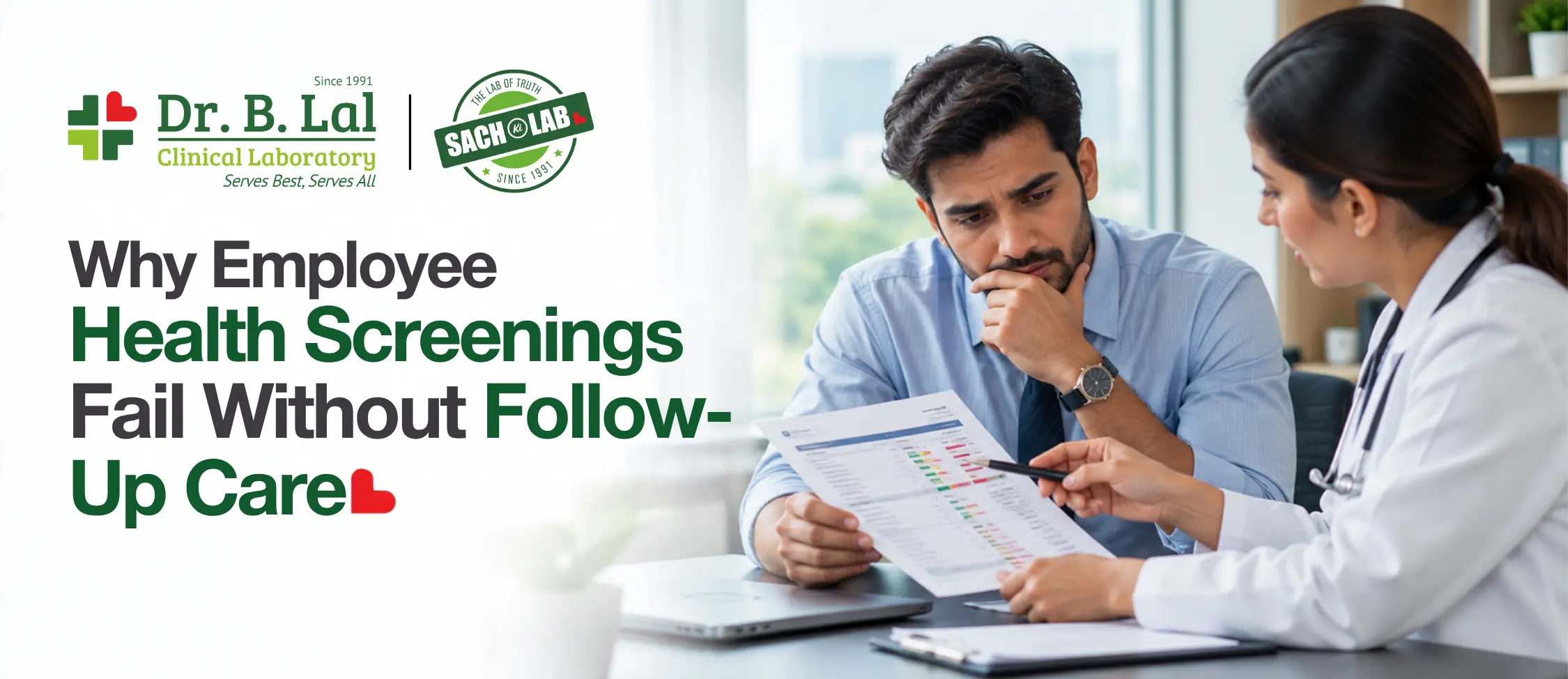
Every year, thousands of companies run the same event: a health tent shows up in the office, employees get their blood pressure, cholesterol, and glucose checked, and a few weeks later a printout lands in their inbox with some numbers on it. Then, in most cases, nothing else happens. This isn't a hypothetical failure mode — it's the default outcome for a huge share of corporate screening programs, and it's exactly why so many of them fail to move the needle on employee health at all, despite the very real cost of running them.
Employee Health Screenings Without Follow-Up Care Just Produce Data, Not Outcomes
This is really the core problem, and Quest Diagnostics puts it about as plainly as it can be put: without an established plan for actionable next steps, screening results become inert data rather than springboards for change. A number on a page doesn't lower anyone's blood pressure. It doesn't get someone with a newly flagged HbA1c into treatment. The screening event itself is just measurement — the actual health improvement, if it happens at all, comes entirely from what occurs after the numbers are collected, and that's precisely the part most programs skip.
Employee Health Screenings Without Follow-Up Care Miss the Moment People Are Actually Listening
There's a specific, narrow window right after someone gets an abnormal result where they're genuinely paying attention to their own health — more so than almost any other point in the year. Programs that hand over a printout and stop there miss this window entirely, and it rarely reopens on its own. As one workforce health analysis put it, this isn't just a missed opportunity for the individual, it directly undercuts the program's own ROI, since the employer has already paid for the screening but captured none of the behaviour change it was meant to trigger.
Employee Health Screenings Without Follow-Up Care Can Leave Real Risk Undiscovered in Practice
Biometric screening programs are genuinely good at identifying people with newly flagged conditions or risk factors — that part works. The problem is what happens next: for these results to actually mean anything, the individual has to take action, and research on this specifically has found that unless people independently seek care on their own initiative, the opportunity to intervene early is simply lost. In effect, a program can technically "detect" a risk and still fail completely at doing anything about it, because detection and intervention are two entirely different steps, and only one of them was built into the program.
Employee Health Screenings Without Follow-Up Care Rarely Change Actual Health
This is worth being blunt about, because it's easy to assume the screening itself is doing something just by existing. It isn't. Biometric screenings on their own don't actually improve employee health — they're a snapshot, not an intervention. Research reviewing corporate wellness programs consistently finds that the least effective ones are exactly the kind where the employer does nothing beyond running the screening itself, while the most effective ones use the same screening data specifically to design and deliver real interventions afterward. The screening and the intervention aren't two versions of the same thing — one is diagnostic, the other is where the actual health outcome lives.
Employee Health Screenings Without Follow-Up Care Can Turn Into an Anxiety Event Instead of a Health One
This is a genuinely underappreciated failure mode. A number handed over with no context, no explanation of what it means, and no clear next step doesn't just fail to help — it can actively cause worry with nowhere productive for that worry to go. Guidance on running these programs properly is specific about this: without a follow-up structure in place, a screening becomes an anxiety event rather than a health intervention. Numbers delivered with real clinical context within the first week or two, followed by a genuine follow-up touchpoint around the six-month mark, turn out to matter as much as the screening itself in determining whether the experience helps or just unsettles people.
Employee Health Screenings Without Follow-Up Care Cost More in the Long Run Than They Save
The financial case for follow-up isn't abstract. People with diagnosed diabetes have annual medical expenditures 2.6 times higher than their peers without it, and diabetes-related absenteeism alone costs employers an estimated $5.4 billion every year in the U.S. Catching risk factors early through screening only translates into savings if that early detection is actually followed by intervention — otherwise, the employer has paid for the diagnostic step while the far more expensive downstream costs of an unmanaged chronic condition arrive on schedule anyway. In effect, a screening program with no follow-up structure can end up more costly overall than not screening at all, since some employees end up chasing unnecessary or poorly guided follow-up tests on their own, without any coordinated support from the program that flagged the issue in the first place.
What Employee Health Screenings With Real Follow-Up Care Actually Look Like
The programs that see genuine results share a fairly consistent structure: results delivered with clinical context, not just raw numbers, ideally through a real conversation with a licensed provider rather than an emailed PDF; a clear, specific next step attached to each flagged result — a virtual consultation, a referral, a targeted awareness campaign for whatever risk showed up most in a particular team; and a genuine touchpoint later, often around six months out, to check whether anything actually changed. Some organisations build this by embedding screening data directly into an ongoing care relationship, so that a flagged risk triggers a coordinated response from a care team rather than leaving the employee to figure out their own next move. The common thread across all of it is that the screening becomes the starting point of a longer process, not a standalone annual event that resets every year with no memory of what came before.
Conclusion
A health screening without follow-up care isn't really a wellness program — it's a data-collection exercise that happens to look like one. The actual value of screening comes entirely from what happens afterward: whether a flagged risk leads to a real conversation, a referral, or a genuine change in support, versus simply sitting in someone's inbox as a number they don't know what to do with. Employers investing in screening without building out the follow-up structure around it are paying for the easy half of the process and skipping the half that was actually supposed to justify the cost.