If a doctor has ordered a CRP test, an ESR test, or both, it's fair to wonder why two different tests are needed to check for the same thing — inflammation. The short answer is that they're not really measuring the same thing, even though they're often grouped together as "inflammatory markers." They pick up on inflammation through different biological processes, respond on different timelines, and end up being useful in different situations. Once you see how each one actually works, it becomes a lot easier to understand why your doctor picked one over the other, or ordered both.
What CRP Measures
C-reactive protein, or CRP, is made by the liver and released directly into the bloodstream in response to inflammation, infection, or tissue injury. What makes it clinically useful is how quickly it reacts — CRP levels can start rising within about 6 hours of an inflammatory trigger and typically peak around 48 hours later. It also tends to fall back down fairly quickly once the underlying issue resolves, which makes it a good marker not just for spotting inflammation, but for tracking whether treatment is actually working.
A standard CRP test is reported in mg/L, and a more sensitive version — high-sensitivity CRP, or hs-CRP — is used to detect much lower-grade inflammation, most notably in cardiovascular risk assessment, where even mildly elevated levels over time have been linked to higher heart disease risk.
What ESR Measures
Erythrocyte sedimentation rate, or ESR, works completely differently. It doesn't measure a specific protein at all — instead, it measures how quickly red blood cells settle to the bottom of a vertical tube over one hour. Inflammation causes certain proteins in the blood, particularly fibrinogen, to make red blood cells stick together and form clumps that sink faster than they normally would. A higher ESR, in other words, is an indirect signal of inflammation rather than a direct measurement of it.
Because this process depends on red blood cell behaviour and overall plasma protein levels, ESR reacts more slowly to changes in the body — it takes longer to rise after inflammation starts and longer to come back down once it resolves. ESR is also influenced by factors that have nothing to do with inflammation at all, including age, sex, anaemia, and pregnancy, all of which is why interpreting a raised ESR always needs some context.
The Key Differences, Side by Side
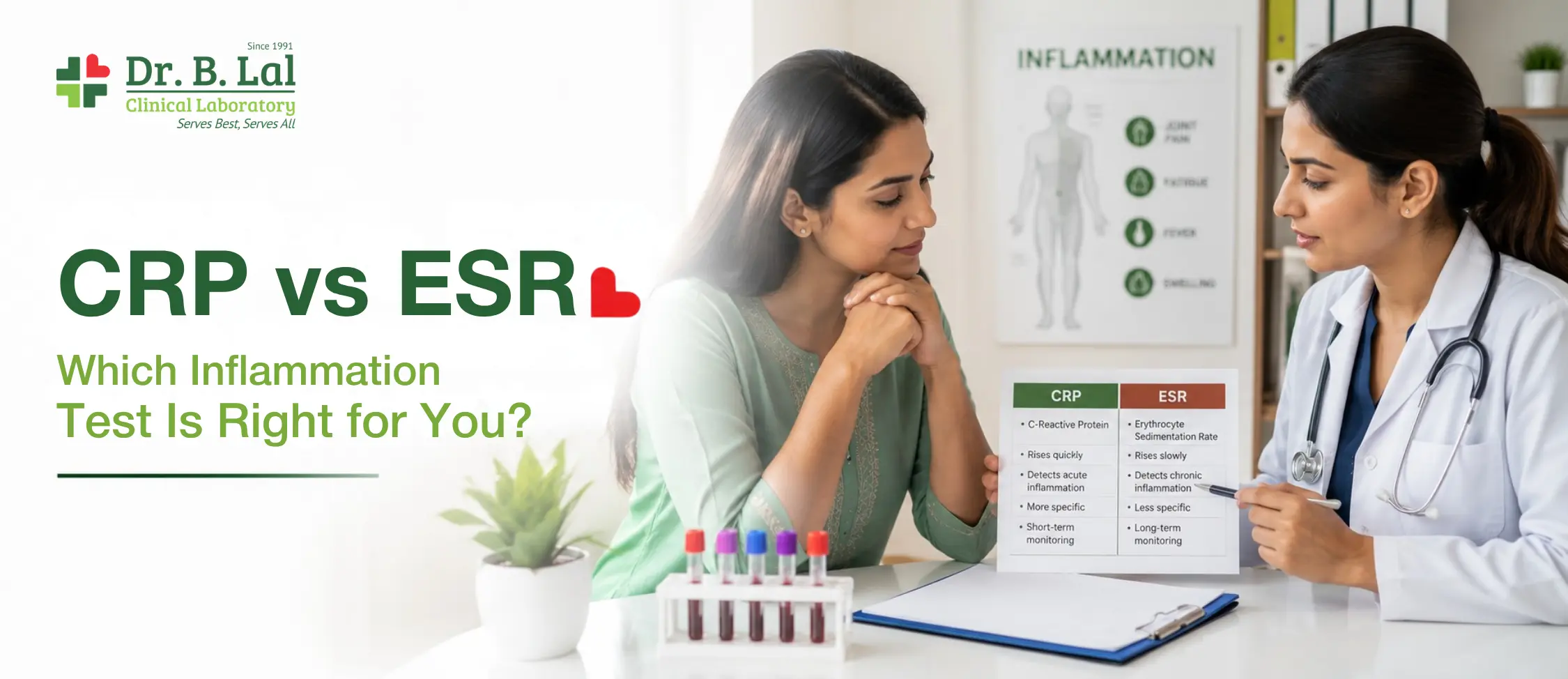
| CRP | ESR | |
| What it measures | A specific liver-produced protein | How fast red blood cells settle |
| Speed of response | Rises within hours, peaks around 2 days | Rises and falls more slowly |
| Best for | Acute inflammation, infection, monitoring treatment | Chronic or longer-term inflammatory conditions |
| Affected by non-inflammatory factors | Less so | More so — age, sex, anaemia, pregnancy |
| Typical use | First-line test for suspected acute inflammation | Specific conditions like giant cell arteritis, ongoing disease monitoring |
When Doctors Reach for CRP
Because it responds quickly and isn't as easily thrown off by unrelated factors, CRP has become the preferred first test in most situations where acute inflammation or infection is suspected. It's commonly used for:
- Suspected bacterial infections, where a sharp CRP rise can support the diagnosis
- Monitoring how well antibiotics or anti-inflammatory treatment are working, since CRP tends to drop quickly once the underlying problem improves
- Post-surgical monitoring, where CRP typically normalises within about two months under normal recovery, making a lingering elevation a useful early flag for complications
- Cardiovascular risk assessment, using the more sensitive hs-CRP version, generally checked twice a few weeks apart and averaged for a more reliable reading
Book Now - CRP Test
When Doctors Reach for ESR
ESR hasn't been pushed out of use — it still plays a genuinely important role in a smaller set of specific situations, particularly ones involving longer-term or more chronic inflammatory activity:
- Giant cell arteritis and polymyalgia rheumatica, where ESR remains the more established screening and monitoring test
- Rheumatoid arthritis and other chronic inflammatory joint conditions, where ESR is often tracked over time as part of assessing disease activity
Situations where a slower-moving, longer-term picture of inflammation is more useful than a fast-changing snapshot
Book Now - ESR Test
Can They Disagree With Each Other?
Yes, and this is actually one of the more clinically useful aspects of ordering both together in certain situations. Because CRP rises and falls quickly while ESR moves more slowly, a high CRP alongside a normal ESR often points to a very recent, early-stage inflammatory process — the ESR simply hasn't caught up yet. This pattern is sometimes seen in early infection, or in some presentations of rheumatoid arthritis.
When the two tests genuinely disagree over a longer stretch of time rather than just a snapshot, doctors don't usually treat it as a red flag on its own — it's more often a cue to look at the full clinical picture rather than relying on either number in isolation.
So, Which One Do You Actually Need?
In most everyday situations — a suspected infection, unexplained fever, or checking how well treatment is working — CRP is generally the more useful and more commonly ordered test, largely because it reacts faster and is less affected by unrelated factors like age or anaemia. ESR still holds its place for a handful of specific chronic conditions, particularly certain rheumatological and vascular conditions where its slower, steadier signal is actually an advantage rather than a limitation.
Neither test tells you what's causing the inflammation — they simply confirm that inflammation is present and give a rough sense of its intensity. That's exactly why your doctor will always interpret the result alongside your symptoms, history, and often other tests, rather than reading a single number in isolation. If you're not sure why a particular test was ordered in your case, it's a perfectly reasonable question to ask your doctor directly — the answer usually comes down to how quickly they need an answer, and what kind of inflammation they suspect.