
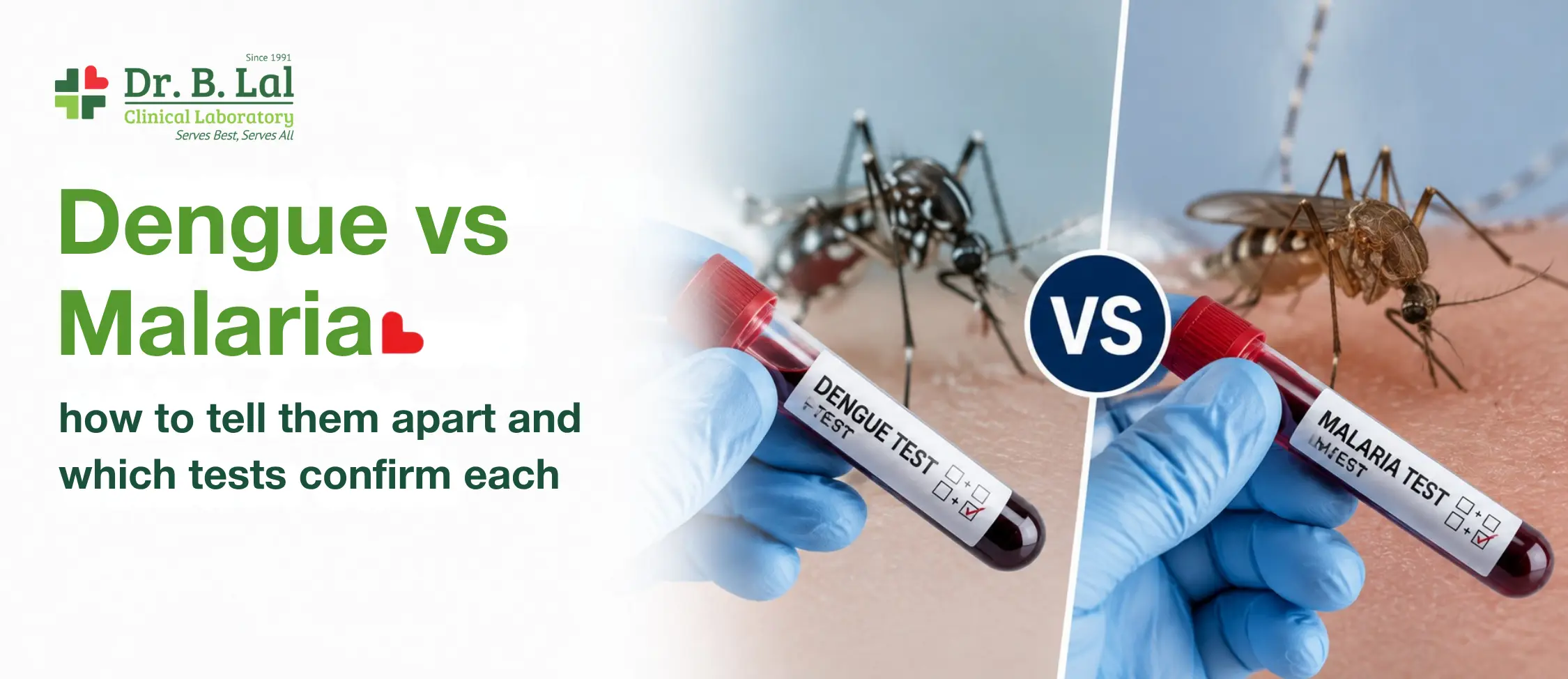
A sudden high fever after monsoon season sends most people's minds straight to one of two places: dengue or malaria. Both are mosquito-borne, both start with fever, chills, and body aches, and both can genuinely knock you flat for a week or more. But they're caused by entirely different organisms, need entirely different tests to confirm, and, this is the part that actually matters most, respond to completely different treatments. Guessing between dengue vs malaria based on symptoms alone is a real risk, not just an academic distinction.
Dengue vs Malaria: Different Cause, Different Mosquito Entirely
This is where the two diseases actually part ways at the most basic level. Dengue is caused by a virus, transmitted primarily by the Aedes aegypti mosquito, the same species behind Zika and chikungunya. Malaria is caused by a completely different kind of organism entirely, a parasite from the Plasmodium family, spread by the Anopheles mosquito.
This distinction matters far beyond biology trivia. Aedes mosquitoes are day-biters, most active during early morning and late afternoon, and tend to breed in small pockets of clean, standing water, flower pots, coolers, discarded tyres. Anopheles mosquitoes, by contrast, are primarily active at dusk and through the night, and tend to breed in larger bodies of stagnant water. Knowing which one bit you are isn't something most people track, admittedly, but the timing and location of exposure can sometimes offer a useful early clue alongside symptoms.
Dengue vs Malaria: How the Fever Pattern Differs
Fever is the one symptom both diseases share, but the pattern it follows often looks different. Malaria classically presents with cyclical fever, a distinct cold stage of shivering and chills, followed by a hot stage with high fever, followed by profuse sweating as the fever breaks, often repeating every 48 to 72 hours depending on which Plasmodium species is involved. Dengue fever tends to be more sustained and less rhythmically cyclical, though it can show a biphasic pattern - breaking briefly around day three or four before returning.
Neither pattern is airtight enough to diagnose on its own, and clinical research bears this out directly, studies looking at febrile patients in dengue- and malaria-endemic regions have found that clinical signs and symptoms often can't reliably distinguish between the two, or rule out co-infection with both at once. This is exactly why symptom-watching, however useful for narrowing things down, isn't a substitute for testing.
Book Dengue Test
Book Malaria Test
Dengue vs Malaria: Other Symptoms Worth Noticing
Beyond fever, a few symptom differences can offer useful clues, even if they're not definitive on their own:
- Rash is considerably more associated with dengue than malaria, a flushed appearance early on, sometimes followed by a more widespread rash later in the illness
- Severe muscle, joint, and bone pain is such a hallmark of dengue that it earned the old nickname "breakbone fever" - malaria tends to cause aches too, but usually less intensely
- Retro-orbital pain - pain specifically behind the eyes, has been associated with both dengue and malaria, and interestingly, research has found it's particularly notable in cases where someone is co-infected with both at once
- Platelet count tends to drop more sharply and more consistently in dengue, sometimes significantly, while malaria more commonly causes only a mild reduction
None of these differences are reliable enough to settle the question on their own, which is exactly why the actual diagnosis always comes down to laboratory testing.
Dengue vs Malaria: The Tests That Actually Confirm Dengue
For suspected dengue, the NS1 antigen test is typically the first test ordered, since it detects a specific dengue viral protein and is most reliable within the first 5 to 7 days of illness, a positive result during this window is strong evidence of active infection. Sensitivity for NS1 testing varies across studies, generally running somewhere in the 60 to 70% range on its own, which is why it's often paired with an IgM antibody test, checking whether the immune system has started producing antibodies against the virus; combining NS1 and IgM results together meaningfully improves overall detection compared to either test alone. A PCR test, detecting the virus's genetic material directly, offers the highest sensitivity and specificity but is typically reserved for cases needing more definitive confirmation, since it's more resource-intensive than the rapid tests. A CBC showing low platelets and white blood cells alongside a positive NS1 or IgM result rounds out a fairly confident dengue diagnosis.
Dengue vs Malaria: The Tests That Actually Confirm Malaria
For suspected malaria, blood smear microscopy, examining a drop of blood under a microscope to directly visualise the Plasmodium parasite inside red blood cells, remains the gold standard, and it has the added advantage of identifying exactly which Plasmodium species is responsible, which meaningfully affects treatment choice. Rapid diagnostic tests (RDTs) detect malaria-specific antigens and deliver results in under 15 minutes, making them genuinely useful where microscopy isn't immediately available, though they're generally considered somewhat less sensitive than a well-performed blood smear. PCR testing for malaria offers the highest sensitivity of all three methods and can detect even very low levels of parasites in the blood, though like dengue PCR, it's typically used for confirmation in more complex or ambiguous cases rather than as a first-line test everywhere.
Dengue vs Malaria: Why Confirming the Right One Actually Matters
This isn't a purely academic distinction, treatment for the two diseases is fundamentally different. Malaria, being a parasitic infection, is treated with specific antimalarial medications, chosen partly based on which Plasmodium species is confirmed and regional drug-resistance patterns. Dengue has no antiviral cure at all, management is entirely supportive, focused on fluids, fever control, and monitoring, with a specific caution against taking aspirin or ibuprofen due to bleeding risk, a concern that doesn't apply the same way with malaria. Treating one disease as though it were the other, or simply guessing and self-medicating, genuinely risks the wrong approach entirely, which is exactly why lab confirmation isn't optional here.
It's also worth knowing that dengue and malaria co-infection does happen, particularly in regions where both diseases circulate simultaneously, which is one more reason a proper diagnostic workup, rather than symptom-matching, is the safer route.
Conclusion
Dengue vs malaria comes down to a virus versus a parasite, spread by two different mosquitoes, with genuinely different symptom patterns, different confirming tests, and, most importantly, completely different treatments. Fever pattern, rash, joint pain, and platelet trends can offer useful hints, but none of them settle the question definitively on their own. If you're dealing with a sudden fever during mosquito season, the safest and fastest path forward is getting tested properly, NS1 and IgM for dengue, a blood smear or RDT for malaria rather than guessing based on symptoms alone.